
Ask most product teams where their time actually goes and the answer is rarely invention. It goes into writing briefs, chasing specifications, waiting for a simulation to finish, reconciling feedback from four channels, and rebuilding a deck because the cost model moved. The creative part is a small fraction of the calendar.
That is why AI for product development has landed differently from other enterprise software. It attacks the waiting and the rework rather than the ideas. A McKinsey study of forty product managers found generative AI lifted individual productivity by around 40 percent while shortening product time to market by about 5 percent, which is a useful pair of numbers. The personal gain is large and immediate. The organisational gain is smaller and slower, because a product launch is gated by decisions, approvals and tooling that no assistant can bypass on its own.
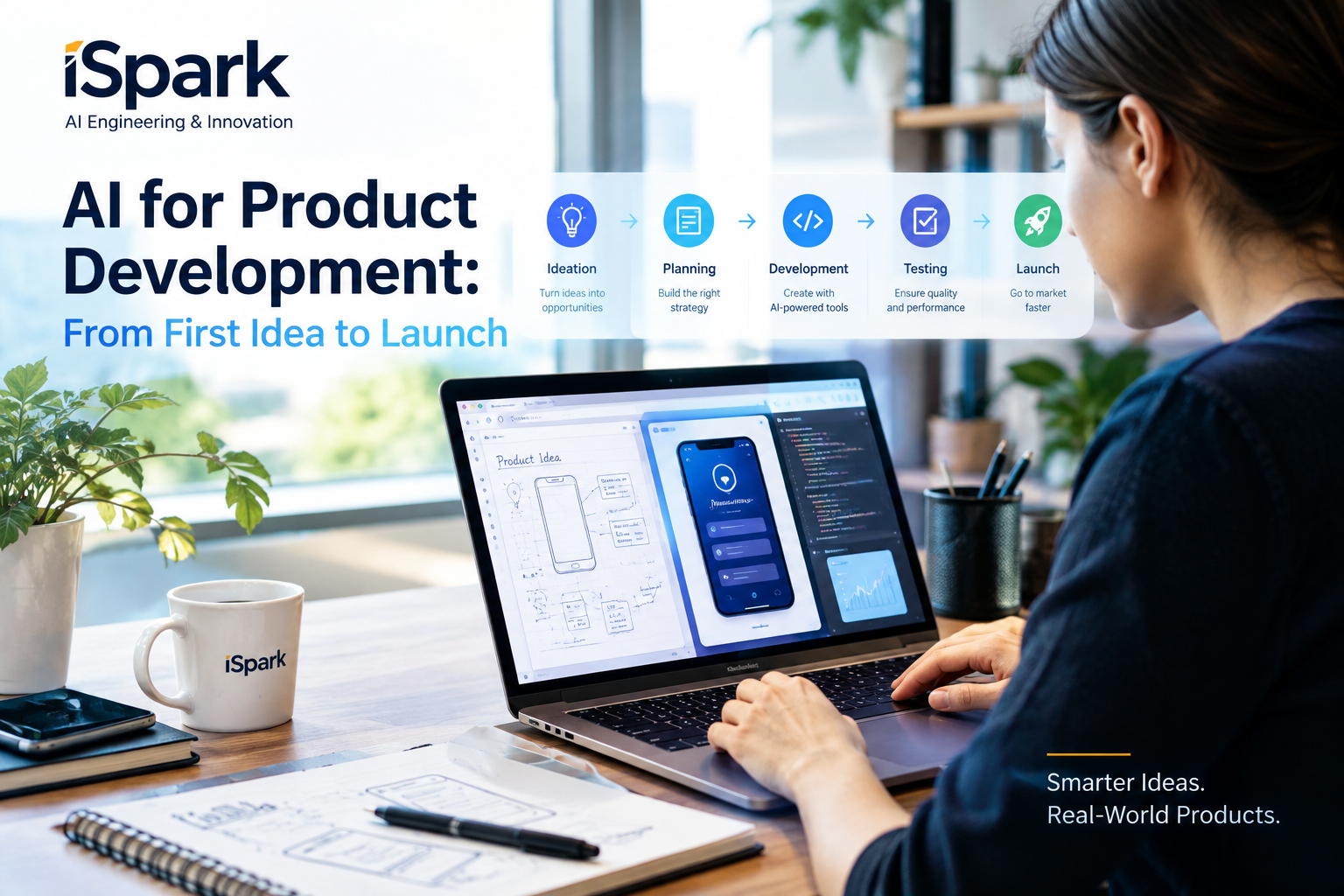
At iSpark we see the same pattern across hardware and software clients. This article walks through what AI realistically does at each stage from ideation to launch, a documented example from a US manufacturer with real numbers attached, the mistakes that stall a first year, a checklist you can apply immediately, and where the field is heading.
What Actually Changes at Each Stage of the Product Development Process
The honest framing is that AI compresses some stages heavily and barely touches others. Knowing which is which stops teams from buying tools for the wrong problem.
| Stage | Where AI helps most | What it cannot do |
|---|---|---|
| Ideation | Generating and clustering large concept sets quickly | Decide which concept fits your strategy |
| Customer research | Synthesising interviews, tickets and reviews at volume | Tell you what people would actually pay for |
| Design and engineering | Design variants against cost, weight and manufacturing constraints | Own the trade off between cost and brand |
| Prototyping and testing | Simulation triage, defect pattern detection, test case generation | Replace physical validation or certification |
| Launch | Drafting collateral, documentation and localised variants | Fix a weak proposition with better copy |
The strongest results cluster in the middle of that table. AI in product ideation produces volume, and volume is only useful if your team has a reliable way to kill 95 percent of it. Our work with product and R and D teams usually begins by fixing the selection process before adding any generation capacity, because otherwise you have simply moved the bottleneck downstream.
Customer Insight Is Where Most Teams Get the Fastest Return
Product organisations sit on years of support tickets, sales call notes, review text and churn interviews that nobody has time to read. AI for product research reads all of it and reports patterns with examples attached. This is genuinely useful, with one caution: people describe problems well and solutions badly. Treat extracted feature requests as symptoms, not specifications. Microsoft’s published guidance on using AI to accelerate consumer goods time to market makes a similar point about grounding design decisions in consumer data rather than intuition alone.
A Real Example: Eaton and Generative Design
The challenge. Eaton, the power management company whose operational headquarters sits in Ohio, faced long lead times on new product design. A single lighting fixture needed input from thermal, electrical, mechanical, optical and manufacturing engineering, and each round of cross functional review added weeks. Margin pressure and sustainability targets tightened the constraints further.
The solution and implementation. Eaton built a generative design capability on its own historical product design data, combined with cost modeling and its existing simulation portfolio, so that candidate designs were evaluated against real manufacturing cost and performance targets rather than geometry alone. The work depended on the quality of the historical data far more than on the model itself.
The outcome. Eaton reported reductions in new product design time of up to 87 percent. In the lighting fixture case, a design cycle of roughly sixteen weeks came down to about two.
The business impact. Faster design cycles meant more shots on goal within the same engineering budget, and earlier cash from launches. Worth noting what did not change: certification, tooling and supply lead times stayed exactly where they were, which is why the headline design saving does not translate one for one into launch date savings.
Common Mistakes in AI Driven Product Development
- Generating more concepts without improving the process that eliminates them.
- Letting AI write requirements that nobody senior reads before engineering starts.
- Assuming a design time saving shortens the launch date. Usually another constraint takes over.
- Using synthetic user feedback as a substitute for talking to real customers.
- Building on product data that has never been cleaned, then blaming the model.
- Ignoring intellectual property questions around generated designs and training data.
Best Practices Checklist
- Instrument your current stage gate timings before introducing any tool.
- Keep a human owner accountable for every requirement, however it was drafted.
- Feed models real constraints, including cost, tolerance and supplier limits.
- Validate generated designs physically. Simulation narrows the field, it does not close it.
- Version and review prompts and templates the same way you review code.
- Agree ownership and licensing terms for generated output in writing, early.
How to Get Started
- Map where calendar time is actually lost across your last three launches.
- Pick the single largest queue, not the most interesting problem.
- Run a six to ten week pilot with one team and one measurable gate.
- Compare against the recorded baseline, not against expectation.
- Scale only after the pilot team has stopped needing help to use it.
Future Trends in AI Product Development Tools
Three directions look credible. Simulation and generative design are converging, so cost, thermal and manufacturability checks increasingly happen inside the design loop rather than after it. Agentic tools are starting to run multi step tasks such as building a test plan and executing it against a build. And provenance is becoming a procurement question, with buyers asking which data a design tool was trained on before they sign.
Key Takeaways
- AI compresses design and research heavily, and barely touches certification, tooling or supply.
- Selection capacity, not generation capacity, is the real constraint in most product organisations.
- Eaton’s reported 87 percent design time reduction rests on historical design data, not on the model alone.
- Measure against a recorded baseline or you will not know what changed.
Frequently Asked Questions
What is AI for product development in simple terms?
It is the use of AI to speed up research, design and testing work, so teams evaluate more options within the same budget and calendar.
Will AI shorten our launch dates?
Sometimes. Design time usually falls first, but certification, tooling and supply lead times often become the new constraint on the overall launch date.
Which stage should we automate first?
Start where calendar time is genuinely lost, which for most teams is customer research synthesis or design iteration rather than the ideation stage itself.
Is AI product design safe for regulated products?
It can be, provided generated designs go through the same validation, testing and certification route as any other design, with full documentation retained.
Do we need our own model?
Rarely. Most value comes from applying general models to your own product data. Build only the part that is genuinely specific to you.
Where to Take This Next
The teams getting real value are not the ones generating the most concepts. They are the ones that measured where their calendar actually goes, fixed the worst queue, and kept validation standards intact while doing it. That approach is less exciting and considerably more likely to survive contact with a launch schedule.
If you want an honest assessment of which stage of your process would benefit and which would not, iSpark runs fixed scope reviews that end with a clear recommendation either way. Bring your last three launches and the timings, and start there.