
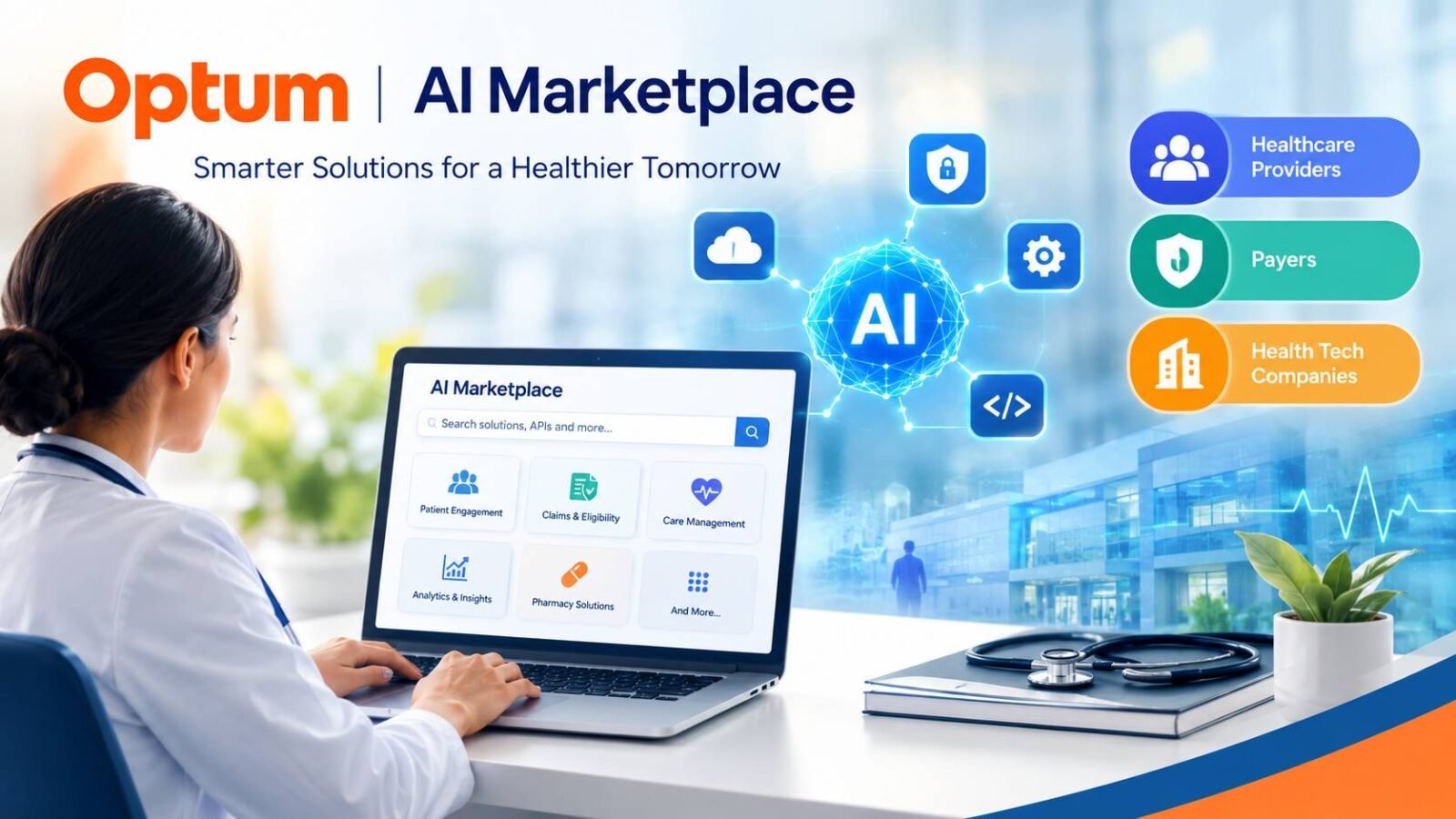
The Optum AI Marketplace is an online catalog where healthcare organizations and developers can find, test, and buy software, APIs, and services built with artificial intelligence. Optum, which is part of UnitedHealth Group, launched it on June 25, 2025. Its stated aim is to help payers, providers, and health technology companies adopt AI without building every tool themselves.
This guide covers what Optum has publicly said about the marketplace, who it is built for, how buying works, how it compares with other healthcare technology marketplaces, and what to check before adopting any AI product listed there. Where Optum has not published details, such as specific pricing or eligibility rules, the article says so.
What Is the Optum AI Marketplace?
Optum’s launch announcement describes a centralized, healthcare-specific ecosystem of curated solutions and APIs that are ready to implement. The marketplace’s own About page puts it more plainly: a place to explore, test, and purchase software, APIs, and services built with AI. Some products come from Optum. Others come from partner companies.
It helps to be clear about what it is not. It is not a consumer app, a symptom checker, or a single AI model you subscribe to. It is a business-to-business storefront, so patients looking for Optum’s care, pharmacy, or financial services will use other Optum sites.
Optum also calls the marketplace the only healthcare-specific AI digital platform of its kind. That is the company’s own positioning, and you should read it that way.
If your AI experience so far is limited to general-purpose assistants, the difference matters. A tool like ChatGPT is a flexible assistant for drafting, research, and everyday tasks, and a guide such as ChatGPT for Small Businesses shows how that kind of tool gets used.
The Optum AI Marketplace sits at a different layer. It lists specialized products meant to plug into healthcare workflows like eligibility checks, claims, and clinical documentation, and those products come with their own integration, security, and contracting questions.
Optum, UnitedHealth Group, and the Companies Behind the Listings
Optum describes itself as an information and technology-enabled health services business with more than 310,000 people worldwide, and states that it is part of UnitedHealth Group (NYSE: UNH). UnitedHealth Group is also the parent of the health insurer UnitedHealthcare. The marketplace is operated by Optum, not by UnitedHealthcare, but the shared corporate family is worth keeping in mind (more on that below).
At launch, Optum said the marketplace would feature products from Optum alongside ServiceNow, Microsoft, and Google. The current homepage also highlights partners including Suki, DeliverHealth, Parakeet Health, Nirvana OneVerify, John Snow Labs, and Hyro. The distinction matters in practice.
When you evaluate a third-party product, that vendor’s capabilities, terms, and security practices are what you are really assessing. The marketplace’s contact form also notes that, for applicable third-party products, submitting a request means your information may be shared with the third-party seller.
Who Can Use the Marketplace?
Optum’s launch release names three audiences: healthcare technology companies, providers, and payers. The site also supports developers through a separate developer portal, which the About page says includes documentation, Swagger files, sandbox access, sample code, and changelogs.
The marketplace website is publicly reachable, but it is aimed at organizations and developers. Optum has not published eligibility requirements, minimum organization sizes, or other access restrictions, and access, pricing, and terms likely vary by product. If you are unsure whether your organization qualifies for a specific listing, the practical answer is to ask through the site’s contact options.
How the Marketplace Works
Based on Optum’s public pages, the process has four parts.
- Discovery. You can browse by category or describe your use case to the “AI Marketplace Helper,” a beta assistant on the site. The assistant carries a notice not to enter personally identifiable information or protected health information, which is a good habit with any AI tool you are only starting to evaluate.
- Testing. Optum says buyers can try products through sandbox access and trials before committing. For API products, a sandbox lets technical teams test calls against sample data rather than live patient records.
- Purchasing. The site includes a cart, a quotes area, account management, and a “Contact sales” option, so the buying path appears to vary by product. Optum says it offers flexible contracts, including pay-as-you-go options, plus streamlined contracting with fewer legal steps and immediate access after purchase. It also says product details and pricing are available to support decisions. Optum does not publish a general price list, and prices depend on the product.
- Ongoing updates. Optum says the catalog is updated regularly and runs a bi-weekly newsletter, so what you see today may differ from what existed at launch.
What AI Tools and Solutions Are Available?
The homepage organizes the catalog into these categories:
- Patient and Member Engagement
- Eligibility and Claims
- Care Operations and Management
- Payment and Reimbursement
- Analytics and Insights
- Optum Real for Medical
- Optum Real for Dental
- Pharmacy Solutions
- Data Access and Interoperability
A few featured listings show the range. Optum Real APIs for Medical Providers give providers real-time insight into eligibility, benefits, prior authorization, and member responsibility data across multiple payers. Fierce Healthcare reported that Optum Real was being piloted with UnitedHealthcare and with Allina Health.
Suki’s ambient clinical intelligence converts clinical conversations into structured data for documentation and coding. CareSelect Risk Assessor pulls patient data from a connected EHR to generate breast cancer risk scores using the Tyrer-Cuzick model.
Not everything in the catalog is generative AI. Some listings are APIs or established software, and the homepage summary for CareSelect, for example, does not describe it in AI terms. Optum’s launch release also said future additions would focus on prior authorization, payment integrity, and autonomous clinical documentation, but those are stated plans, not confirmed products. Read each listing for what it actually does.
How the Optum AI Marketplace Compares With Other Marketplaces
These platforms do not all compete for the same job, so a feature-by-feature ranking would mislead. The table compares them on purpose and audience, using only what is publicly established.
| Optum AI Marketplace | Epic Showroom | Cloud provider marketplaces (such as AWS Marketplace or Google Cloud Marketplace) | |
|---|---|---|---|
| Primary purpose | Explore, test, and buy healthcare AI software, APIs, and services | Helps health systems find vendors that integrate with Epic’s EHR | Broad catalogs of software deployable on that cloud platform |
| Operator | Optum (UnitedHealth Group) | Epic | The cloud provider |
| Healthcare focus | Healthcare-specific | Healthcare-specific, centered on the Epic ecosystem | General, with healthcare among many categories |
| Typical buyers | Payers, providers, health tech companies, developers | Epic’s provider customers and vendors that integrate with Epic | Organizations of any industry |
| Integration | APIs, sandbox, developer portal; EHR integration varies by product | Built around integration with Epic software | Depends on the listing and the cloud environment |
| Pricing | Varies by product; Optum says details are available per listing | Set by each vendor | Set by each seller |
Epic’s Showroom replaced its earlier App Market as a way to connect health tech companies with providers. Microsoft and Google also appear inside Optum’s marketplace as partners, and Optum and Microsoft have partnered on Optum Real, so the lines between these ecosystems are not clean. Many organizations will use more than one of them depending on their EHR, cloud environment, and the problem they are solving.
What Optum Has Not Made Public
Several questions that buyers care about do not have public answers yet:
- Pricing. Optum points to product-level details and quotes, not a rate card.
- Eligibility. No published rules on who can purchase which products.
- Outcomes tied to the marketplace. Optum’s analyst recognitions on the site reference reports from 2022 and 2023 on broader Optum services, not the marketplace itself.
- Compliance specifics. Optum says products are reviewed with data privacy and responsible AI principles in mind, and the site links to a page on its commitment to cybersecurity. The public marketplace pages do not list specific certifications or standards for individual products, so request that documentation directly.
What to Consider Before Adopting Healthcare AI
Privacy and HIPAA
HHS guidance says a cloud service provider that creates, receives, maintains, or transmits electronic protected health information on behalf of a covered entity is a business associate, and a business associate agreement is required. HHS’s cloud computing guidance also says organizations should conduct their own risk analysis. Whether a given marketplace product involves PHI, and who signs what with whom, depends on the product and your role. A marketplace listing is not a substitute for that analysis.
Interoperability and payer rules
For tools touching eligibility and prior authorization, the regulatory backdrop is the CMS Interoperability and Prior Authorization final rule (CMS-0057-F). It requires certain payers to implement FHIR-based APIs and improve prior authorization processes, with API requirements scheduled for January 2027. That rule applies to specific payers, not to the marketplace as a whole, and nothing public confirms that a given Optum product satisfies it. Ask vendors precisely which standards their product supports.
Clinical risk and oversight
Any AI that influences clinical decisions needs validation against your patient population, clear human review steps, and a governance owner. Depending on what a piece of software does, it may also fall under FDA oversight as a medical device, so ask the vendor about regulatory status.
Everyday AI use by staff
Adopting a vetted product does not settle how staff use other AI tools. People who learned the basics from resources like How to Use ChatGPT should know that consumer chat tools are not the place for patient information unless your organization has approved the tool and has the right agreements in place. A short written policy prevents most problems.
The vendor relationship
Because Optum sits within a corporate family that includes a major insurer, payers and providers may want to understand how data is used, what is shared across business lines, and how the contract treats that data. This is a diligence question, not an accusation. It is worth asking about any large vendor with multiple business lines.
How to Evaluate Whether a Listing Fits
Start with the problem, not the catalog. Then put each candidate through these questions:
- What specific workflow does this improve, and how will we measure it?
- Is it AI, an API, or conventional software, and what does the AI actually do?
- Who is the vendor (Optum or a third party), and whose terms apply?
- Will it connect to our EHR, clearinghouse, or payer systems, and who does the integration work?
- What data does it touch, where is it processed, and what agreements cover it?
- What evidence of performance exists, and was it measured in settings like ours?
- What does it cost at our volume, and what are the exit terms?
An illustrative scenario (hypothetical, not a real Optum customer): a mid-size physician group spends hours each week verifying eligibility and chasing prior authorizations. It identifies that as its single biggest administrative drag, shortlists two API products from the Eligibility and Claims category, tests both in a sandbox with its IT team, and asks each vendor for security documentation and a sample agreement. It then runs a limited pilot in one clinic and compares staff time and denial rates before and after. The point is the sequence, not the specific products.
Final Takeaways
The Optum AI Marketplace is best understood as a buying and testing channel for healthcare-specific technology, run by a large vendor and populated by both its own and partner products. Its public materials explain the concept and categories well, but they leave pricing, eligibility, and product-level compliance details to direct conversations.
A practical next step: pick one administrative or clinical workflow that costs your team the most time, browse the matching category, and use the sandbox to test one or two candidates against your real integration needs. Before any purchase, request security documentation and the agreement terms in writing.