
Supply chain teams have spent the past few years being asked to do two contradictory things at once. Hold less inventory, and never run out. Cut supplier costs, and reduce risk. The tension is not new, but the margin for error has narrowed, and spreadsheets running on last quarter’s assumptions are no longer good enough to manage it.
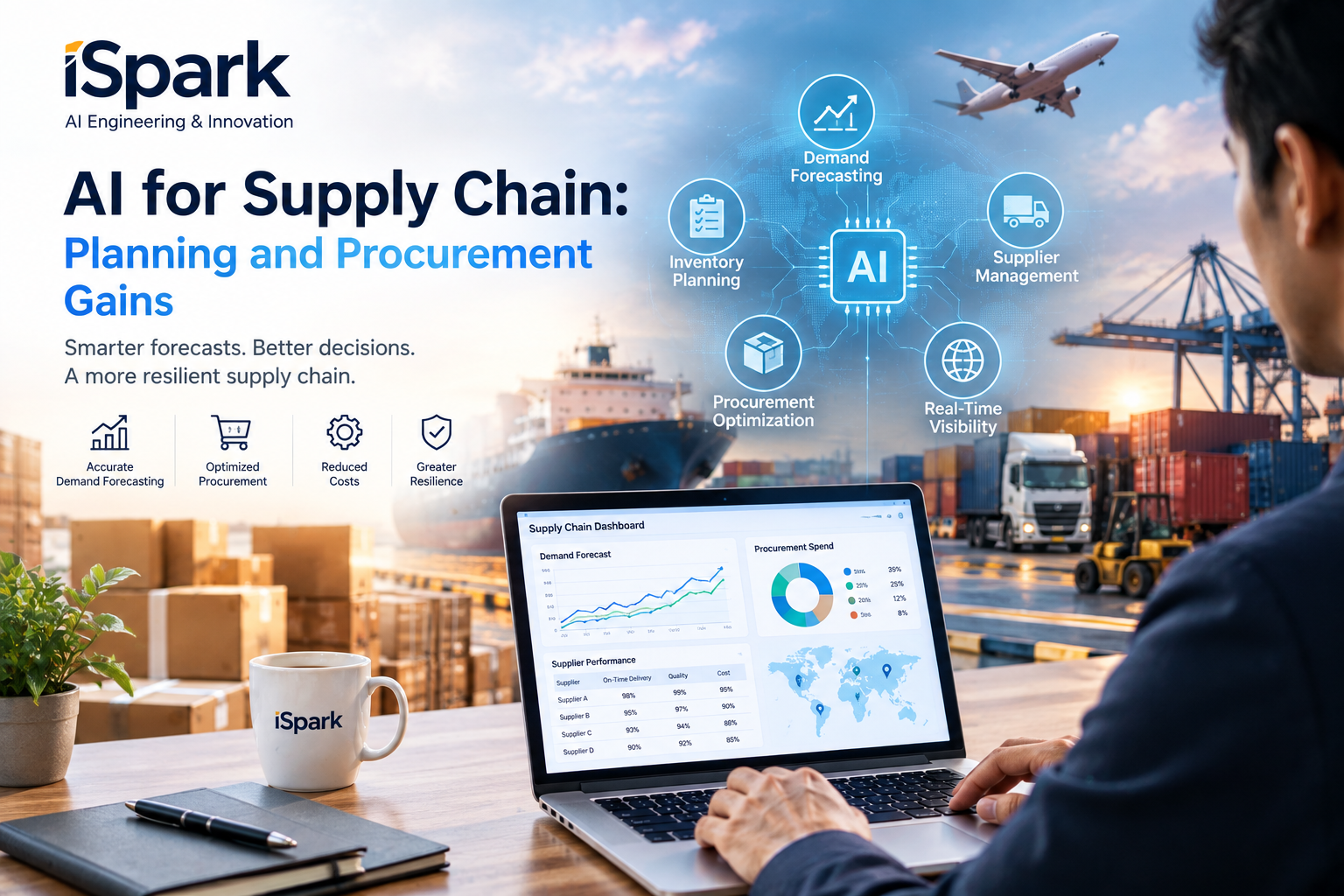
AI for supply chain is genuinely useful here, though not in the way most vendor decks suggest. It is not a system that plans your network for you. It is a set of tools that forecast with stated uncertainty, spot patterns across data too large to read, and take mechanical work out of procurement so buyers can spend time on the supplier conversations that actually change outcomes. Gartner has predicted that by 2026 more than 75 percent of commercial supply chain software would include advanced analytics or machine learning as standard, which means the question is shifting from whether to adopt to what to do with it.
At iSpark we work with operations and procurement leaders on exactly that question. This article covers where AI supply chain optimization produces results, a documented example from a US company with published numbers, the mistakes that waste a first year, a checklist, and how to begin.
The Uncomfortable Truth About Supply Chain Data
Before any of the use cases matter, one thing has to be said plainly. Your most important supply chain data belongs to somebody else. Supplier capacity, tier two dependencies, actual lead time variability, real production status: these live outside your systems, and no model can infer them from your purchase orders alone.
That shapes where to start. The projects that succeed early are the ones built on data you already control, such as your own demand history, your own inventory positions, and your own contracts and invoices. Our work on AI for supply chain and procurement teams usually opens by reconciling contracted commercial terms against what was actually invoiced, because that exercise is cheap, uses data you own outright, and more often than not recovers money before any model is built.
Where AI Demand Forecasting and Procurement Automation Help
| Use case | What AI contributes | Honest limitation |
|---|---|---|
| Demand forecasting | Forecasts using price, promotion, weather and event signals | Cannot predict genuinely new products or shocks |
| Inventory positioning | Safety stock tuned to real lead time variability | Depends on lead time data you may not record |
| Logistics and route planning | Optimised multi stop routing and trailer loading | Needs accurate delivery window data |
| Procurement automation | Contract term extraction, invoice matching, sourcing prep | Contract quality varies wildly across suppliers |
| Supplier risk | Monitoring external signals across a supplier base | Weak below tier one, where exposure often sits |
A note on risk scoring. Composite supplier risk scores are popular and rarely actionable, because they compress very different problems into one number. Mapping single points of failure, meaning the components with one qualified source or one site, tends to be more useful than any score. Cloud platforms now package much of the forecasting and planning machinery, and AWS Supply Chain is a reasonable illustration of what that layer looks like when the data model is unified first.
A Real Example: Walmart and Route Optimization
The challenge. Walmart runs one of the largest private fleets in the United States. At that scale, small routing inefficiencies compound into enormous fuel cost, emissions and driver hours. Planning multi stop journeys against delivery windows, trailer capacity and store constraints is a combinatorial problem well beyond manual scheduling.
The solution and implementation. Walmart built its own AI driven route optimization technology, covering automated route mapping, trailer packing and minimising miles travelled. The work took years and deep operational knowledge, and it won the Franz Edelman Award in 2023 for deployment at scale. The company was explicit that building this capability in house was a barrier most businesses could not clear, which is why it later offered the software to others through Walmart Commerce Technologies.
The outcome. Walmart reported eliminating 30 million unnecessary miles driven, bypassing 110,000 inefficient paths and avoiding 94 million pounds of carbon dioxide.
The business impact. Lower fuel and transport cost, better asset utilisation and a measurable emissions reduction that supports reporting obligations. The strategic outcome is arguably more interesting. An internal logistics capability became a product Walmart sells, which is what happens when operational advantage is built rather than bought.
Common Mistakes in AI Driven Supply Chain Planning
- Starting with supplier risk, where you control the least data, instead of demand, where you control the most.
- Replacing a planner’s judgement rather than giving them a better starting position.
- Reporting forecast accuracy as a single number instead of by product tier and horizon.
- Ignoring override rates. A plan everyone overrides is telling you something important.
- Buying a network optimisation platform before master data is clean enough to trust.
- Treating a composite risk score as a decision rather than as a prompt to investigate.
Best Practices Checklist
- Baseline your current forecast error before anything is built, by segment.
- Beat a naive forecast first. A meaningful share of proposals do not.
- Record lead time variability, not just average lead time. Variability drives safety stock.
- Reconcile contracted terms against actual invoices at least once a year.
- Map single points of failure across components and sites, and keep the map current.
- Give planners a visible override path and treat high override rates as feedback.
How to Get Started
- Pick one category or region where demand data is clean and volume justifies attention.
- Measure current forecast error and current stock cover as your baseline.
- Run a pilot against that baseline over at least one full seasonal cycle.
- Track the decisions that changed, not just the accuracy that improved.
- Extend to procurement work such as invoice matching, where value is easy to prove.
Future Trends in AI Supply Chain Management
Expect three shifts. Agentic procurement tools will start handling routine sourcing steps such as request for quotation preparation and supplier follow ups, with human approval on commercial terms. Regulatory reporting requirements around emissions and deforestation are pushing traceability deep into supplier tiers, which creates demand for data extraction at scale. And planning tools are moving from producing a single forecast toward producing scenarios with explicit confidence ranges, which is a better fit for how planners actually decide.
Key Takeaways
- Start with data you own. Demand, inventory and contracts beat supplier risk as a first project.
- Forecast improvement only matters if a planning or buying decision changes as a result.
- Walmart’s route optimization shows what sustained internal investment produces, not what a quick pilot delivers.
- Single point of failure mapping is more actionable than any composite risk score.
Frequently Asked Questions
What does AI for supply chain actually improve first?
Usually demand forecasting and inventory positioning, because those rely on data you already own and produce measurable changes in stock cover and service levels.
Can AI predict supply disruptions before they happen?
Partially. It monitors external signals well at tier one, but visibility below that depends on supplier cooperation rather than on modelling capability.
How much data do we need to start?
Two to three years of clean demand history for a defined category is usually enough. Coverage of one segment beats patchy data across everything.
Does AI procurement automation replace buyers?
No. It removes matching, extraction and administrative work, which gives buyers more time for negotiation and supplier development, where the real value sits.
What is a realistic first year outcome?
Reduced forecast error in one category, lower safety stock without service loss, and recovered spend from contract and invoice reconciliation. Network redesign comes later.
Where to Take This Next
The supply chain organisations getting value from AI are not the ones that bought the biggest platform. They are the ones that started where they owned the data, beat a naive baseline before claiming success, and treated planner overrides as information rather than as resistance to change.
If you want an independent view of which part of your planning or procurement process would benefit and which would not, iSpark runs fixed scope assessments that end with a written recommendation, including recommending no further work where that is the honest answer. Your contracts and your demand history are the place to start.